
Churches need to make more training available to their group leaders. That is the conclusion of an overwhelming number of pastors who responded to the Lifeway Research survey The State of Groups 2024.
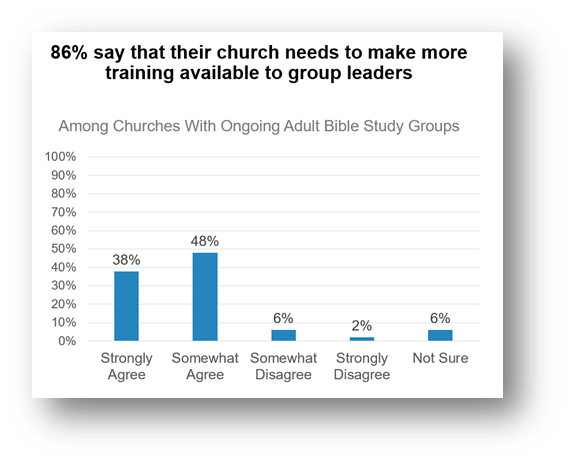
Almost 9 in ten church leaders strongly or somewhat agreed that more training should be made available to group leaders.
Going all the way back to the first Sunday School Superintendent of the Southern Baptist Convention, Arthur Flake, you can find appeals from notable leaders like Flake who urged churches to train their workers. Back in 1920, enlisting and training new workers was Flake’s third step in his now famous 5-step formula for growing a church’s group ministry. For 125 years, the company I work for, Lifeway Christian Resources, has championed the training of group leaders.
There is almost no profession that does not require its workers to receive ongoing training. Real estate agents, teachers, first responders, fast food workers, and many, many more kinds of employees are required to go through continuous learning and training. Because the church is focused on sharing the life-changing message of the gospel, how much more earnest should the church be in providing training for group leaders?
Aubrey Malphurs made the following statement about the importance of training in his book, Building Leaders. “If we ask our people to lead any ministry of the church, we’re responsible to provide them with continual leadership training. If we can’t do this, we have no business asking them to serve, doing both them and the ministry an injustice. Without ongoing training, our recruits will struggle and often fail, and the rest of the ministry will experience the effects in the resulting leadership vacuum” (p.27).
In my 30+ years of leading group ministry in the local church, I have discovered seven effective ways to increase the kinds of training events that I provide to my group leaders. Think of this as having multiple hooks in the water – the more hooks, the more fish you catch. When it comes to training, one size doesn’t fit all. Which of the following have you tried, and which ones should you consider trying this year?
#1 – Host In-Person Events – In-person events are convenient, with many churches preferring to conduct these kinds of trainings on Sundays, immediately following the last worship service of the morning. Group leaders are already on campus, and most don’t mind remaining for a “lunch and learn” opportunity. In-person events also create a sense of community and camaraderie, which helps build relationships and a sense of family among the group leaders. When community is built and people feel part of a team, they tend to remain in their leadership roles from year to year, reducing turnover and giving the church consistency in group leadership.
#2 – Conduct Training via Zoom – Wise church leaders will continue to take advantage of online technology that we all used during the COVID pandemic years. Zoom provided groups with a virtual way to be together when social distancing rules were in place. Now that we have used that technology, it is relatively easy to conduct a training event online. Think of the advantages of this kind of training: people can participate from anywhere, the training can be recorded and shared with those who could not attend the training, and you don’t have to provide meals, snacks, and drinks! I would not recommend a steady flow of virtual events, but one a year (if you are conducting quarterly training) fits nicely into a training strategy for the year.
#3 – Attend Associational Events – Your local association provides training for its churches, and it tends to be very cost effective, or even free. You could go to your association’s website, discover what trainings are available for the year, and commit to promote the event and challenge your group leaders to attend it together. In the past, I loaded up thirty to forty group leaders in church vans, transported them to an associational training event, and then paid for their lunches afterwards as a thank-you for taking time out of their Saturday to be trained. In the end, this kind of training is cost effective, and it’s fun to be together with fellow group leaders from the church. The drive to and from the event and the conversations that take place are invaluable in creating a team atmosphere.
#4 – Pass Along Podcasts and Webinars – As you discover podcasts and webinars that are crafted to help group leaders learn new skills, pass along links occasionally and invite group leaders to take 30 minutes and invest in their ongoing learning about group ministry. I lead one such podcast, Disciple-making in Community. You can find it at lifeway.com/dmcpodcast.
#5 – Create a YouTube Training Channel – A growing number of churches have discovered the benefits of creating their own training, delivering it online through their own branded YouTube channel. Short videos that last no more than 5 to 7 minutes allow you to “drip out” training to your group leaders in short bursts. You don’t have to have studio quality equipment – in fact, it’s probably best that you don’t! Use your smartphone, record a short message, and upload it to your YouTube channel for “on demand” viewing.
#6 – Send Regular Emails to Group Leaders – Occasionally I like to send out a mass email to my group leaders and include a quotation from a book I’m reading on group ministry. I find that doing this accomplishes three important things. First, it communicates that I am a leader/reader, and I am learning about group ministry so that I can more effectively lead all groups in my church. Second, it allows me to quote someone else about an issue that we have in our group ministry, which gets a conversation started. Third, it allows me to invite the group leaders to begin a discussion in an email string about the content found in the quote. I can provide training for my group leaders through this simple action at a cost of zero dollars.
#7 – Partner with other Local Churches – I love it when three or four churches come together in a city to do more training than any one of them could do by themselves. If four churches banded together, they could host an annual training event, rotating it through the four churches. If the pastor of the host church became the plenary speaker at each event, and if church staff from the host church (and/or associational personnel) led breakouts, churches could put together some fine training events that people would enjoy attending.
#8 – Subscribe to Ministry Grid – Lifeway’s Ministry Grid is an online platform that delivers not only digital curriculum, but also training. At last count, there are over 3000+ training videos and over 700+ courses of study! In addition to these videos, a Ministry Grid subscription allows you to place your own training videos on the platform for viewing by your group leaders. To learn more about Ministry Grid, simply go to ministrygrid.com.
One Size Doesn’t Fit All When it Comes to Training
In the book Sticking Points, author Hayden Shaw reminded his readers of the different generations in the workplace (and in our churches). Each generation has training preferences, he said. For instance:
Traditionalists / Seniors
- Lived in rural areas
- Had few books
- Valued classroom education/teacher’s word was law
- Appreciate lectures
- View teachers as authorities
- Appreciate lectures by experts
Boomers
- Grew up with compelling TV and entertainers
- Less tolerant towards poor communicators
- Love group discussion
- Value compelling stories/motivating speakers
- Value certificates/certifications
Generation Xers
- Think keeping current = job security
- Expect organizations to train them
- Little tolerance for lectures like Boomers or Traditionalists
- Training is essential for all, not a reward for the few
- They do not hesitate to question authority
- Won’t believe a trainer simply because the person has a title
Millennials
- Want interaction
- Communicate through video and visual media
- Boring is the kiss of death
- Expect to work in groups/network in the classroom
- Want practical training
- 55% say YouTube is their preferred method of learning
- Prefer face-to-face communication
- Value anytime/anywhere training
- Value shorter sessions
Generation Z
- Will ask a co-worker to train them instead of the boss
- As likely to ask parents as to look it up online
- 60% say YouTube is their preferred learning tool
- 85% of Gen Z has watch at least one online video in last 7 days
 kenbraddy.com
Great word! Thanks, Ken!
Cindy Weatherall | Education Executive Assistant
Office 850.475.1128
olivebaptist.orghttp://www.olivebaptist.org/