
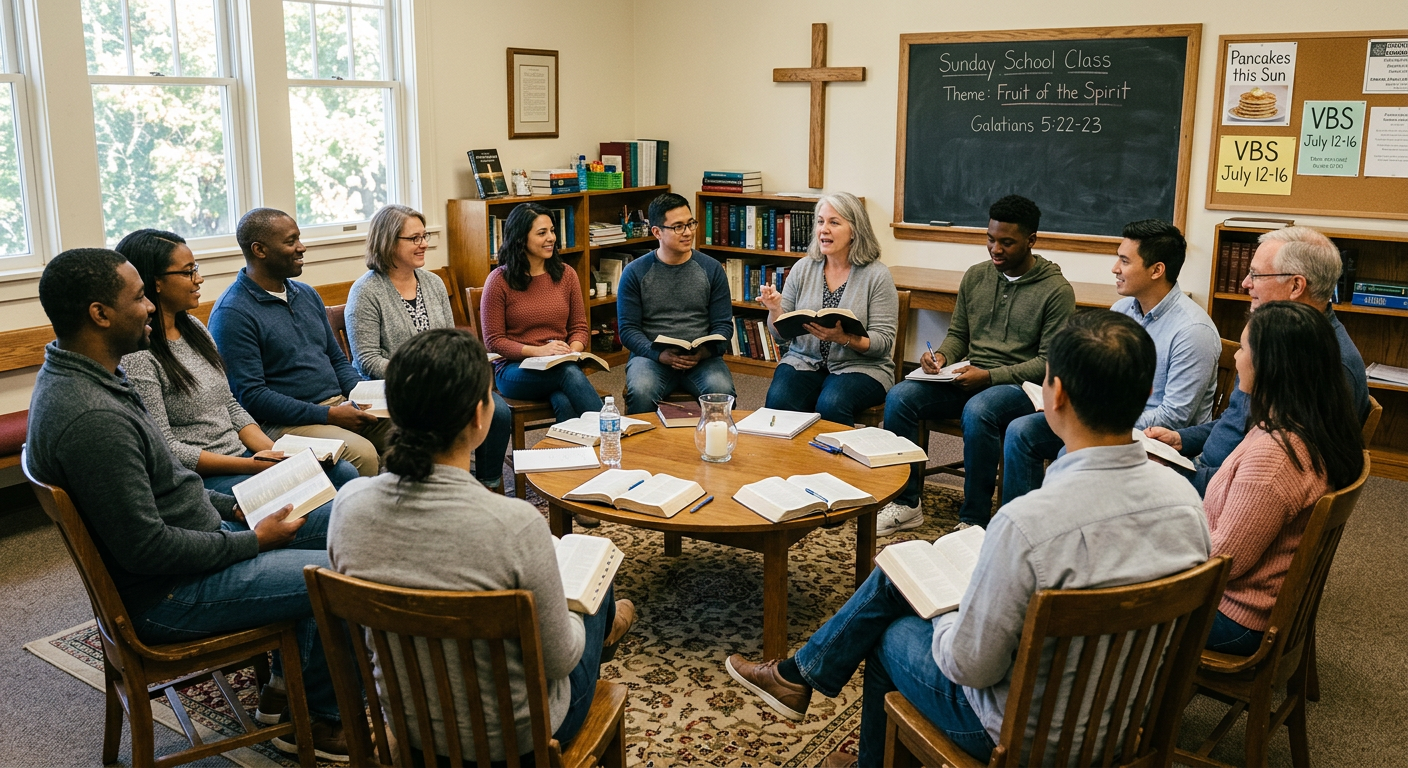
Arranging a Bible study group in a circle isn’t just a cozy aesthetic choice. It’s a structural decision that shapes the tone, depth, and relational strength of the entire gathering. When people sit in rows, the setup naturally creates a “front” and a “back,” a speaker and an audience. But when you shift the room into a circle, something subtle but powerful happens: the group becomes a community. Here are three reasons why that simple change makes a meaningful difference. Even arranging the room in two or three half-circles gives you a big advantage.
1. A circle reinforces shared participation rather than passive listening
The most immediate benefit of a circle is that it visually and practically communicates that everyone has a voice. Rows imply hierarchy—someone teaches, others receive. A circle, on the other hand, signals collaboration. It tells each person, “Your perspective matters here.”
In Bible study, this matters deeply. Scripture comes alive when people wrestle with it together, bringing their experiences, questions, and insights. A circle encourages:
- More natural conversation — People can see each other’s faces, which makes it easier to jump in, respond, and build on each other’s thoughts.
- Greater engagement — When you’re part of the circle, you’re not hidden behind someone’s head. You feel present, seen, and more likely to contribute.
- A sense of ownership — Participants feel like co-laborers in the study, not spectators watching someone else do the work.
The circle turns the study from a lecture into a dialogue, and that shift alone can transform the spiritual depth of the group. If done right, the Bible study will move from a monologue to a dialog, and then on to a “groupalogue.”
2. A circle strengthens relational connection and trust
Bible study isn’t just about information; it’s about formation. And formation happens best in the context of relationships. When people sit in rows, they mostly see the back of someone’s shirt. In a circle, they see eyes, expressions, reactions, and warmth.
This matters because trust grows when people feel known. A circle helps create:
- A safer environment for vulnerability — People are more likely to share honestly when they feel connected to the group.
- A sense of equality — No one is “in the back” or “off to the side.” Everyone is equally included.
- A stronger group identity — The physical shape reinforces the emotional reality: we are in this together.
Over time, this relational closeness becomes the soil where deeper conversations, prayer, and spiritual growth take root.
3. A circle mirrors the early church’s communal posture
While we can’t perfectly reconstruct the logistics of early Christian gatherings, we do know they met in homes, shared meals, and interacted face-to-face. Their gatherings were intimate, participatory, and relational. Just revisit Acts 2:42-47. A circle naturally echoes that spirit.
This setup encourages:
- Mutual edification — The New Testament repeatedly emphasizes believers building one another up. A circle makes that mutuality tangible.
- Shared responsibility — Instead of one person carrying the weight of teaching or discussion, the group collectively explores Scripture.
- Embodied unity — The physical arrangement becomes a symbol of spiritual reality: one body, many members, all connected.
In a world where people often feel isolated—even in crowded rooms—a circle quietly pushes back by creating a space where everyone belongs.
The shape of the room shapes the shape of the community
It’s easy to overlook how much the physical environment influences the spiritual environment. But the truth is simple: circles cultivate connection, participation, and unity in ways rows simply can’t match. When you gather people around Scripture in a circle, you’re not just arranging chairs. You’re creating a space where people can encounter God and one another more deeply.
If you’re planning a Bible study, try the circle. You may be surprised by how much the room itself helps the group grow.

