
Intergenerational Sunday School groups offer something age‑graded or lifestyle‑graded groups simply can’t replicate: a richer, more resilient, more transformative environment for spiritual formation. When people of different ages learn, pray, and serve together week after week, the church becomes more like the family God designed it to be. Here are three major benefits that make ongoing intergenerational groups a powerful addition to traditional models.
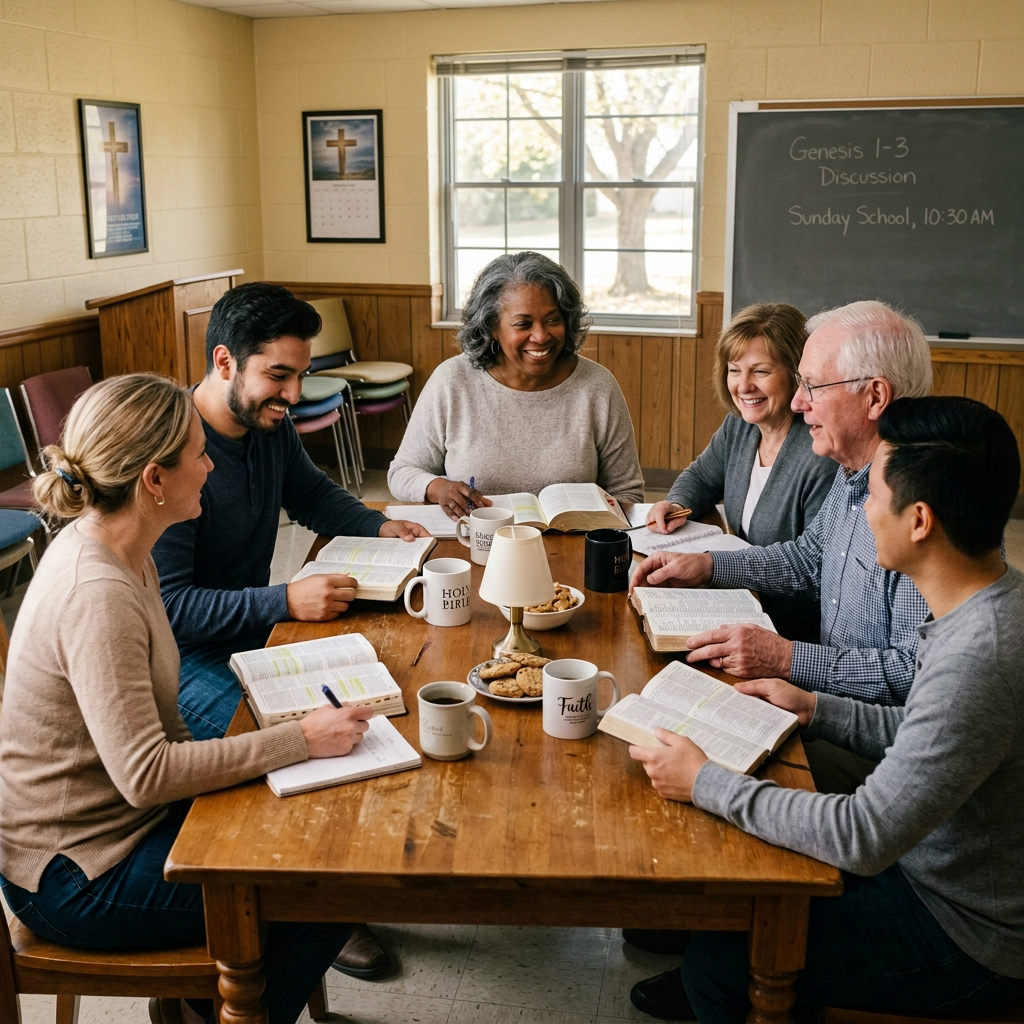
1. Intergenerational adult groups strengthen discipleship by restoring the biblical pattern of spiritual family
Age‑graded groups often unintentionally silo people. While this structure can make teaching easier, it can also limit spiritual growth. Scripture consistently presents discipleship as a multi‑generational experience: older believers investing in younger ones, younger believers learning from seasoned saints, and everyone growing together in community.
Intergenerational Sunday School groups embody this pattern. They create space for:
- Shared wisdom: Older adults bring decades of lived faith, offering perspective younger believers simply haven’t had time to develop.
- Fresh insight: Younger adults and students bring energy, curiosity, and cultural awareness that keeps the group vibrant and relevant.
- Mutual encouragement: People at different life stages remind one another that God is faithful in every season—not just the one they’re currently experiencing.
This dynamic produces deeper discipleship because it mirrors real life. Faith is not lived in age‑graded compartments; it’s lived in families, workplaces, neighborhoods, and churches filled with people of all ages. Intergenerational groups help believers practice that reality every week.
2. Intergenerational groups build stronger relational bonds and reduce isolation
Age‑graded groups can unintentionally reinforce isolation. A young single adult may only interact with other singles. A senior adult may only see peers. Parents may only connect with other parents. While these groups can be helpful, they can also limit relational diversity and create pockets of loneliness.
Intergenerational groups break those barriers.
They create relational bridges that strengthen the entire church:
- Younger adults gain additional spiritual “grandparents” and mentors and receive encouragement and grounding from older believers.
- Older adults experience renewed purpose as they invest in younger generations.
- Generational wisdom and experiences can be passed back and forth between people of different ages and life stages.
These relationships don’t just make Sunday School more enjoyable—they make the church more resilient. When life gets hard, people have a broader network of support. When someone drifts, more people notice. When someone celebrates, more people rejoice. Intergenerational groups cultivate a web of belonging that age‑graded groups rarely achieve.
3. Intergenerational groups create healthier, more stable Sunday School ministries
Age‑graded or lifestyle‑graded groups often rise and fall with demographic shifts. If a church loses young families, the young‑married class collapses. If a senior adult class ages out, it disappears. Leaders must constantly reorganize groups to keep them balanced.
Intergenerational groups, however, are more naturally stable.
They thrive because they are built on diversity, not uniformity. When one demographic changes, the group continues to function. This stability produces several ministry advantages:
- Simpler group organization: Groups don’t require constant restructuring.
- Easier leadership development: Leaders don’t need to match a specific age or life stage—they simply need to shepherd people well.
- Greater long‑term sustainability: Groups remain healthy even as the church’s demographics shift.
- Stronger outreach potential: Guests often feel more comfortable entering a mixed‑age group than one built around a specific life stage they may not fit.
Intergenerational groups help Sunday School ministries avoid the churn and fragility that often accompany age‑graded systems.
Final Thought
Intergenerational Sunday School groups aren’t just another option—they’re a strategic return to the way God designed His people to grow. They deepen discipleship, strengthen relationships, and stabilize ministries. In a world that increasingly isolates people by age, the church can stand out by bringing generations together in ongoing, life‑shaping community.


A big fat AMEN! My current group has been Intergenerational from day 1. I recruited an older gentlemen to co-lead. We birthed it out of a membership class. We then added a father/daughter duo. We range from 20âs to late 60âs and no one really thinks itâs a thing at this point. The outreach factor is huge. Now anyone a class member connected with, new people at church or where they live/work/play, is someone they can invite and not have to hand over to someone the person doesnât know. I am curious to see you debate yourself with a previous post ð https://kenbraddy.com/2018/06/28/limiting-a-groups-age-range-part-2/
Hey Benji, I’m glad to hear that your multi-gen group has been a success. Age graded or lifestyle graded classes definitely have pros – and cons. Because of the discipleship deficit that the latest research is proving (see the Pastors Views of Discipleship survey, State of Theology Survey, and the State of Groups survey at lifewayresearch.com), I am advocating for churches to consider phasing in multi-gen groups as options alongside more traditional age and lifestyle graded classes. Every model has pros and cons, but the multi-gen approach gets the closest to the biblical model.