
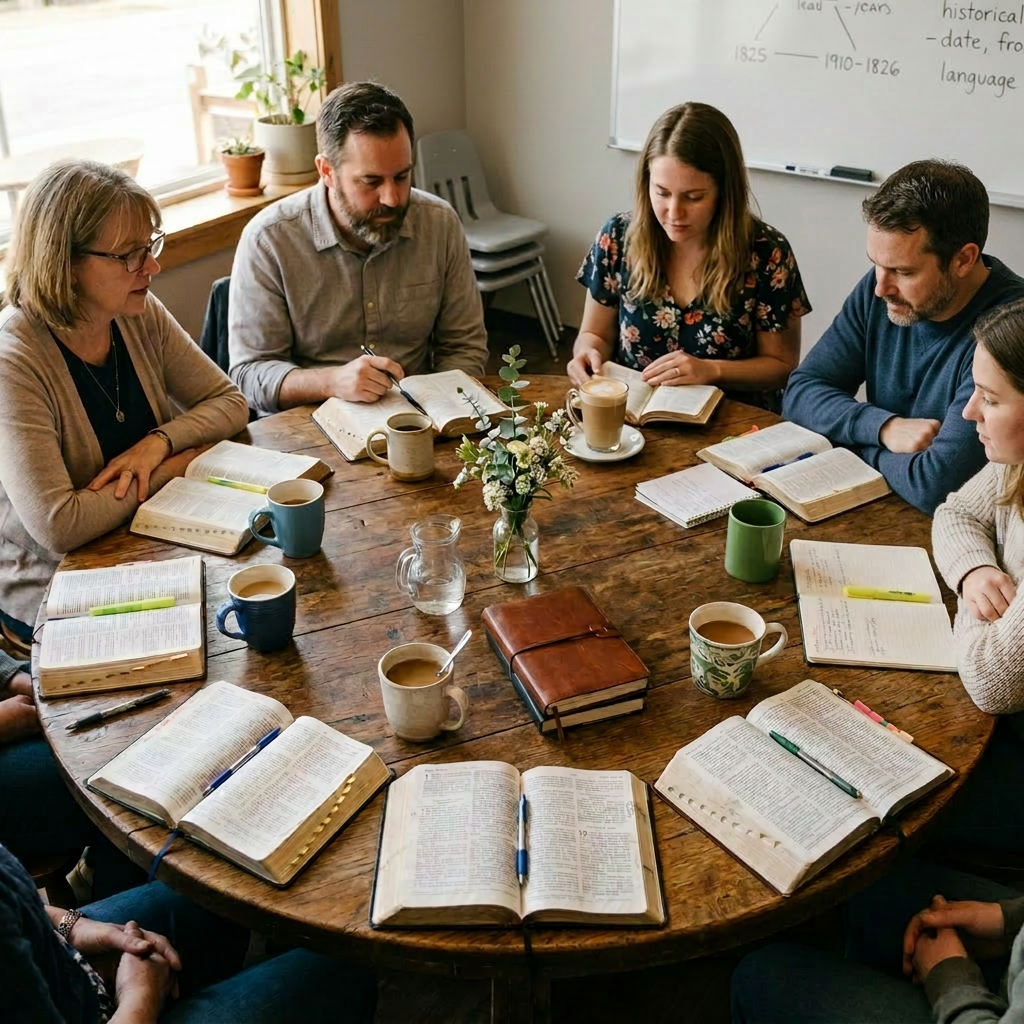
If you’ve ever tried to build community in a room arranged like an airplane cabin, you already know the struggle. Rows of chairs may work for concerts and sermons, but when it comes to Bible study groups, they quietly work against the very things you’re trying to accomplish. Tables, on the other hand, create the kind of environment where discipleship can actually flourish.
I didn’t always think this way.
In the past, I had been taught to arrange rooms in rows of chairs with the main goal of packing in the largest number of people possible. Numerical growth is a fantastic and appropriate goal, but not to the exclusion of helping people develop deeper relationships with others.
If people sit in rows, it creates a “second sermon” environment. When participants look at the back of other people’s heads, conversations are limited and relationships don’t flourish like they can when people are facing one another at a round table.
“Listening does not equal learning” – that’s what David Francis and I said in our book 3 Roles for Guiding Groups. Once a long-time fan of rows and maximizing the meeting spaces of groups, I must acknowledge that we can have our cake and eat it, too: we can grow our church’s group ministry by starting new ones (not just packing people into groups in rows), while using tables within groups to create community and connection. Everyone wins.
Here are four compelling reasons why tables are better than rows of chairs in a group Bible study.
1. Tables Turn Spectators into Participants
Rows of chairs send a subtle message: Sit still. Face forward. Listen to the expert.
That’s great for preaching, but it’s terrible for discussion.
Bible study groups thrive on interaction—questions, insights, shared experiences, and honest conversation. Tables naturally shift the posture of the group from passive to participatory. When people sit around a table, they’re not an audience. They’re contributors.
Tables communicate:
- Your voice matters here.
- We’re learning together.
- This is a conversation, not a lecture.
When people can see each other’s faces, they’re more likely to speak up. When they can spread out a Bible, a notebook, or a cup of coffee, they settle in. And when they settle in, they engage. Tables create the physical environment that supports the spiritual goal: shared discovery of God’s Word.
2. Tables Build Community Faster and Deeper
Rows of chairs create proximity without connection. You can sit shoulder‑to‑shoulder with someone for months and never learn their name. Tables, however, create a natural relational rhythm. They slow people down. They encourage eye contact. They make space for conversation before and after the study.
Think about what happens at a table:
- People talk more freely.
- They laugh more easily.
- They notice when someone is missing.
- They pick up on nonverbal cues—discouragement, joy, confusion, fatigue.
Tables help groups become families.
In a row, you can hide. At a table, you’re known.
And that’s exactly what most people are longing for when they walk into a Bible study group. They want to belong. They want to be seen. They want to be part of something meaningful. Tables accelerate that process by creating a relational environment where trust grows naturally.
3. Tables Support Better Learning and Better Discipleship
Bible study is not just about absorbing information—it’s about transformation. And transformation happens best when people can process, discuss, question, and apply Scripture together.
Tables support that kind of learning.
They make it easier to:
- Look up passages together
- Share resources
- Take notes
- Work through discussion questions
- Pray in smaller, more intimate circles
Rows of chairs reinforce a one‑way flow of information. Tables reinforce a shared journey of discovery.
Jesus didn’t disciple His followers in rows. He gathered them around meals, conversations, and shared experiences. Tables help us recapture that relational, interactive model of discipleship.
4. New leaders will naturally be discovered.
If a group’s meeting space has round tables in it, I will guarantee that at every table, one or two of the eight adults will take the lead when it comes to discussion and relationship-building. A percentage of people are Relational learners (“Relational” is one of the 8 learning approaches), and others simply are better able to lead. These people are not hard to spot, they take the lead, and can be encouraged to step up and lead a group of their own. Tables can be fertile soil in which new leaders grow.
The Bottom Line
If your goal is to create a warm, relational, discussion‑driven Bible study group where people grow spiritually and connect deeply, tables are one of the simplest and most powerful tools you can use. They change the posture of the room, the tone of the group, and the depth of the relationships.
Rows create audiences.
Tables create disciples.

